Your Will Be Done
My musings on what it means to do the Will of God
Deborah Goadman
11/17/20257 min read
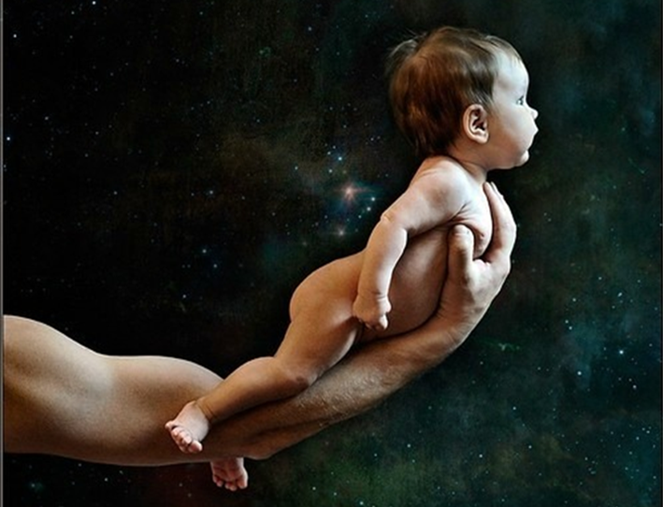
Once upon a time in the Cosmic Mind of God, a Star was created. The Star was destined to be fertilized by human life. So, It was given human form, and the Star was born. God then breathed these words into the Star, “Thy will be done.”
What was God thinking--giving a powerful will to immature beings! Sounds like a recipe for disaster to me. This reminds me of a walk I took with my daughter when she was about 3 years old. She was riding her tricycle. We were three-fourths of the way home when she decided she was going no further. No amount of coaxing was changing her mind. I finally gave up and picked up my screaming, kicking child in one arm and the tricycle in the other and walked the rest of the way home. I don’t know where she got that temperament. It couldn’t have been from me—I was an angel. Well, maybe not always. My cousins and brother told me (after we had grown up) that I was a very stubborn little girl. I was surprised to hear that. I don’t think I am stubborn now, just very determined. I am sure you have your own stubborn child stories; maybe even a few stubborn grownup stories. So asking what was God thinking is a valid question? Let’s explore this question together.
How do you define will? I define it as the freedom to choose, to command. When I think of will being expressed powerfully, I see Jean Luke Picard, the commander of the starship Enterprise from Star Trek--the Second Generation. When he wanted something done he said, “MAKE IT SO.” Like Picard, God made us commanders—commanders of our life. He knew full well that we would run amok using the power of our will so he gave us our very own spiritual guidance system (SGS). It can be our pilot through the uncertain and troubled waters of our life, if that is what we choose. Our SGS always nudges us to pay attention to the best way of expressing our will.
Will can be expressed in three basic ways. It can be expressed as God’s Will, the Collective (Cultural) Will and Self Will. God’s Will is overarching —embracing the big picture. Collective Will is united will of a group. Self Will, of course, is individual choice. Let’s look closer at each of these.
God’s Will is focused on the Universal Good. God’s Will encompasses complete understanding of all His creation, and it expresses His enduring values of truth, beauty, and goodness.
Collective Will is focused on the good of the group. It is founded on the group’s accepted values and these may or may not align with what is truly highest and best for all. Take for example, the family group. In some cultures the family may have a tradition of employment. Sons may be expected to become farmers, miners, doctors and so on, whether they are drawn to that or not. Daughters are typically groomed to be mothers and homemakers. Our culture is a bit more advanced in that daughters can have a career on top of being mothers and homemakers. If ethnic or religious identity is crucial to the group, then daughters and sons are expected to marry within their group. If the group ideal doesn’t fit well with the longings of a member it takes a lot of courage to choose differently.
Self Will is all about the good of me—to fulfill my needs and my desires. It is based on the limited perception of the self. It is always operational whether in automatic (default) mode or creative mode. So when we say, “I didn’t have any choice.” That is not true—we always have a choice even if we don’t like our options and choose not to choose.
We don’t start our human life knowing how to use the full potential of our will. Instead, we usually play the hand life deals us and then we deal with the consequences. This may involve a lot of whining, blaming, cheating, fighting, crying, giving up or celebrating if we like the results. At this stage of our development our will is operating primarily in default mode. As we mature we take on the attitude expressed by Robert Louis Stevenson and others. “Life is not a matter of holding good cards, but of playing a poor hand well.” So we learn to look for the opportunities in every experience for improving ourselves.
If a religious life is important to us then we seek to know God’s Will for us. This is where some real confusion and trepidation sets in! I am going to ask you some questions. I would like you to pay attention to your emotional reaction to each one. What is God’s Will for me? What will God ask of me this time? What sacrifices must I make? (talk about my reactions) These reactions really miss the mark of what it means to do God’s Will. Those of us who have been raised on the teachings of traditional religions have been taught that we should sacrifice our will to God or for the good of our community. The word “should” makes for a really great guilt trip. No wonder God’s Will doesn’t always feel good to us. For example, someone dies and a well-meaning person says. “God took your child because he or she was too good for this world. It was God’s Will.” When a disaster happens, it may be God’s Will to punish evil doers. (Those evil doers may be people whose beliefs or life preferences are different than our own.) We also have mysterious acts of God that insurance won’t pay for. All of this reveals our discomfort when called upon to sacrifice or suppress our personal will to God’s Will. This reflects the usual mindset of our spiritual childhood.
Over time, we learn to intentionally use our will to create desired outcomes with full awareness. This is a gradual process that I organize into two stages: the self-reliance stage and the spirit-reliance stage. While we are in the self-reliance stage, our attempts at creating deliberately produce mixed results. That is because we flip flop between the well- practiced default mode and the newer creative mode. Our results also may not fully satisfy us because we rely mostly on our limited self when using the three aspects of creating deliberately. These three aspects are choosing goals, perspective and guidance system. In this stage we tend to choose goals and a perspective that are self-oriented. Our guidance system, if we use one, usually comes from people we trust, from outside of us. It is all part of the process. We learn by doing and in the process we figure out what works and what doesn’t. I like this statement from Marshall Rosenberg, “If something is worth doing, it is worth doing poorly.” I doubt if many of us have been taught to think like that. But think about what he means. To me he is saying, “Just get started; mistakes are learning opportunities.” Learning to use the power of our will to create consciously is definitely WORTH DOING.
Now let’s look at the Spirit-reliance stage also known as divine partnership. In divine partnership we still use the three aspects of creating deliberating: choosing goals, perspective, and guidance system. We become more skillful at focusing on our goals with a laser beam intention. We choose goals that are stated in positive action language. We state what we want versus what we don’t want. We visualize our goal as specific as possible because that is the best way to visualize a goal into reality. For example, “I am driving my new four door Toyota Prius. It is silver blue with comfortable soft grey velour seats. It has excellent acceleration and of course excellent mileage. The ride is super smooth and quiet. I can feel my excitement of owning that car and I am confident it is coming my way.
We also choose goals that will serve others as well as our self. Most goals will have a positive ripple effect on other people’s lives if that is what we intend. Even if our goal is to get a new car it can benefit others. We helped to enrich the seller’s life while benefiting our own. We can use the car to help others in need. The positive possibilities are endless.
As for perspective: We tap into a greater perspective than that of our limited self. We access more of our innate spiritual vision through prayer and meditation and devotion to divine ideals. We learn to trust our Inner vision more than our outer vision. Our In-sight shapes out-sight. As a result our goals may change as a result of our enhanced awareness.
We choose to follow our divine guidance system to flesh out the details of manifesting our desires. We learn that Spirit is flexible and will re-calculate our path when our goals change. It will always offer us the best possible way of achieving those goals. At last we are in a creative partnership with God.
As we learn to use our will creatively we find ourselves on a journey of discovering how to use the power of will to its fullest potential—the way God planned it to be employed. That journey begins with a commitment to God’s way of doing things, to God’s way of being—God’s way of loving and serving. Our will reaches its greatest potency when our will and God’s will are one. That union will be achieved in the same way that Jesus achieved it—by loving God with all our heart, soul, and mind. From that place of love, God’s way becomes the only way I want to express, to do, or to be.
God’s plan for us is simple. God wants us to we realize our true star potential by choosing to see as God sees and do as God does to the best of our ability. God was first to say “Thy will be done.” The only true gift we can offer in return to a Father who has everything is to say “Thy Will be done.”

Comment on Blog
Share your thoughts or questions anytime here.